Futures day trading community: what value should you expect
A futures day trading community is valuable when it helps you understand the market, not simply when it sends frequent alerts. Look for practical education, clear trade commentary, explanations of margin, active moderation, and a focused tone. Compare the fee with the resources included, and remember that no community removes trading risk or guarantees results.
A paid community may provide more structure or access than a free one, but a fee alone proves nothing. Free commentary can also help you study how traders frame a setup. The key difference is whether the community supports your own decisions or encourages you to follow trades without understanding the risks.
This guide explains how to evaluate those differences. Learn what useful education and live commentary look like, why margin matters, and how moderation, tone, and price shape the experience. Choose a community for disciplined learning and useful context, not noise or promises.
Key Takeaways
- Judge education and trade commentary by whether they help you understand a setup and make independent decisions, not simply react to alerts.
- Understand how margin and leverage can magnify both gains and losses before treating capital efficiency as an advantage.
- Look for moderation that enforces clear risk discussions and a tone that supports disciplined learning; price alone doesn’t prove value.
- Compare paid and free communities by the structure and practical learning they provide, then decide whether the added support fits your needs.
Education, watchlists, and live trade commentary
Strong communities turn futures market information into lessons you can examine and apply independently. Education, software support, and commentary are most useful when they clarify decisions rather than encourage copying.
Futures Trading Education
Futures trading education explains how contracts, positions, and market decisions work, so traders can assess a setup before acting. Lessons may use chart examples, trading software, and broker-platform demonstrations to show how orders appear and how strategies are evaluated. In the United States, Section 1256 contracts receive blended 60/40 tax treatment, according to the Internal Revenue Service. Tax treatment is one reason education should cover more than chart entries.
Strategy Lessons and Performance Reviews
Strategy lessons should explain a method’s conditions, risks, and intended execution. Performance reviews can then compare those rules with actual decisions. For example, a review might assess whether a trader followed an entry plan, managed an open position, and recorded the exit consistently. Reviewing the process helps distinguish a repeatable approach from a lucky outcome. Good educational reviews discuss losing trades and disclose the assumptions behind examples, rather than showcasing wins alone.
Watchlists and Live Trade Commentary
A watchlist identifies markets or price areas to monitor; live commentary explains how a developing setup changes. Useful commentary describes the level being watched, the conditions that could support a trade, and what would invalidate the idea. Treat alerts as material to study, not instructions to copy: execution can differ, and prices may move before you act. Clear commentary makes the reasoning visible.
Online Platforms and Trade Signal Rules
Futures groups operate on dedicated online community platforms, trading forums, and social networks. In the United States, commodity futures and options generally must trade through an exchange by people and firms registered with the CFTC, with limited exceptions. The CFTC requires companies and individuals handling customer funds or giving trading advice to register with the National Futures Association. Treat signal posts as educational commentary, and look for context on entries, exits, risks, and disclosures before drawing conclusions.
Capital efficiency and margin
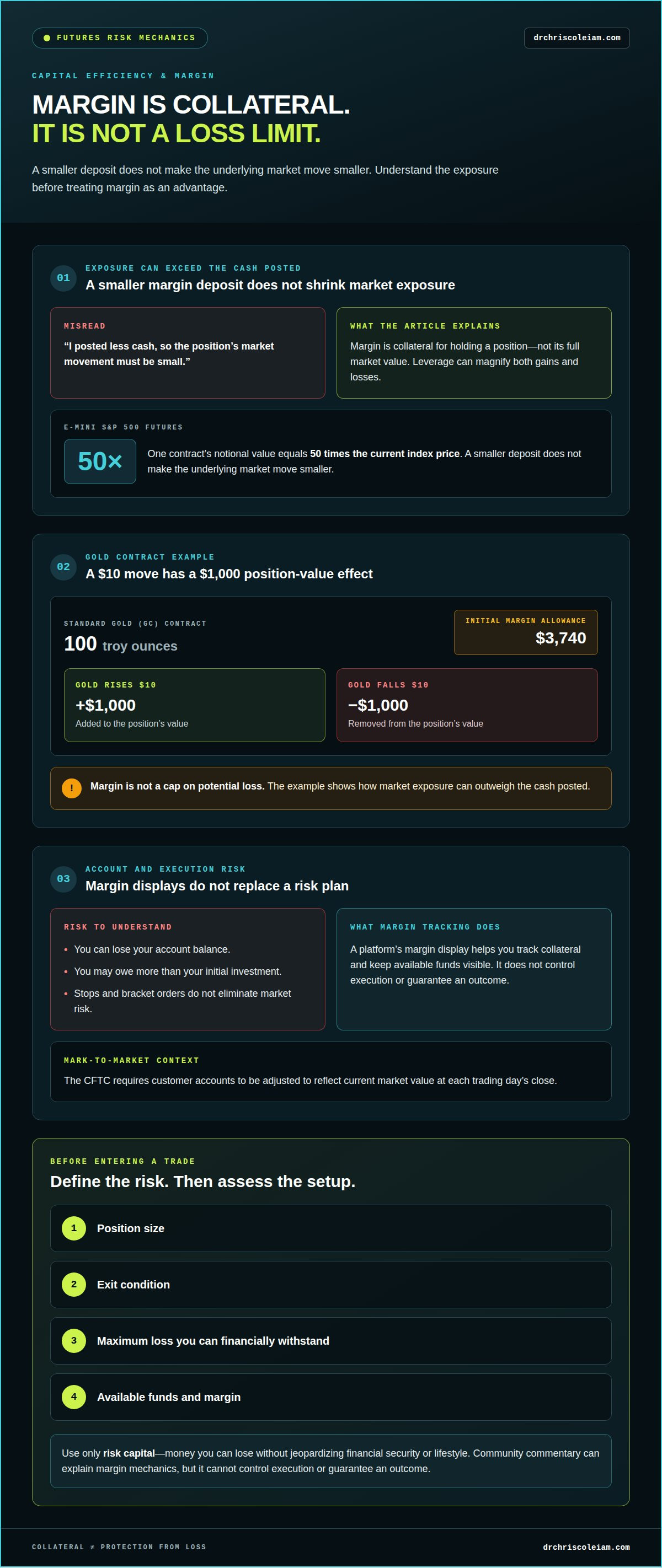
Futures margin is collateral for holding a position, not the position’s full market value. That structure lets day traders control larger exposure with less upfront capital, but leverage cuts both ways. One E-mini S&P 500 futures contract has notional value equal to 50 times the current index price. A smaller deposit doesn’t make the underlying market move smaller. A futures day trading community should explain this distinction clearly, not frame margin as easy buying power.
Consider a standard Gold (GC) futures contract, which represents 100 troy ounces. A $10 increase in gold adds $1,000 to the position’s value; a $10 decline removes the same amount. One example compares that $1,000 move with a $3,740 initial margin allowance, illustrating how quickly market exposure can outweigh the cash posted. Margin is not a cap on potential loss.
That distinction should guide every execution decision. Futures traders can lose their account balance and may owe more than their initial investment. The CFTC requires customer accounts to be adjusted to reflect current market value at each trading day’s close. A platform’s margin display helps you track collateral, but it doesn’t replace a risk plan for open positions. A useful futures day trading community puts these risks into practical context.
Before entering a trade, define the position size, exit condition, and maximum loss you can financially withstand. Bracket orders and stop-losses can help structure exits, while monitoring margin keeps available funds visible. Neither eliminates market risk. Futures day trading in the United States isn’t subject to the pattern day trader rule, but that doesn’t make leveraged trading safer or remove the need for adequate capital.
Use only risk capital, money you can lose without jeopardizing financial security or lifestyle. Community commentary can explain margin mechanics, but it can’t control execution or guarantee an outcome. For structured context around Gold, Nasdaq, and S&P 500 futures, explore Daily Auric Levels for Gold, Nasdaq and S&P 500 Futures.
Choosing a community based on moderation, tone, and price
For beginners, a strong futures community explains its trading rules, risk language, and software examples before promoting directional calls. Look for moderators who welcome questions about losing trades and clarify that discussion is educational, not a promise of returns. You should leave better equipped to assess decisions, not pressured to copy them.
Moderation reveals a room’s standards. Watch for urgent pressure to buy, gains shown without losses, unclear risk rules, or moderators who post entries but omit exits. For example, a post about a Nasdaq entry should explain the context and how the idea was closed or invalidated. Without that record, members can’t assess the full trade.
Tone matters because group language can shape decision-making. A constructive room distinguishes a possible directional setup from certainty and treats a losing position as material for review, not blame. Beginners need room to ask what a chart level means or how a broker platform displays an order. Hype and ridicule make those basic learning steps harder.
Assess price by comparing the specific value included, not by treating a fee as proof of quality. One community may offer lessons and discussion; another may add watchlists, software demonstrations, or live commentary. Match those features to your learning needs and available time. If education is your main priority, frequent trade alerts may be less valuable than clear explanations and reviews.
Account for trading costs beyond membership, too. Futures execution can involve commissions and the bid-ask spread, so frequent entries may affect results even when a posted setup looks favorable. Consider whether community examples discuss these costs and distinguish simulated performance from live execution. Weigh moderation, useful context, and transparent limitations together. No single feature makes a room right for every trader.
Paid versus free trading communities
Compare both formats by the learning they support, using the same futures market and decision criteria.
Paid Trading Communities
A paid trading community charges for access to structured resources, discussion, or commentary. This format may suit traders who want a defined place to study futures contracts, but payment alone doesn’t establish quality. Judge value by what members can actually learn and review, not by the membership label.
For example, a paid room discussing Gold (GC) should explain its market view and relevant risks, not just post a directional call. Look for clear disclosures about membership contents, how trade examples are presented, and whether losing positions are discussed. A substantial fee offers little value if members see entries without enough context to understand the decisions.
Separate the community fee from trading capital and execution costs. They are distinct financial commitments. Before paying for access, decide whether the available lessons or discussion meet a specific learning need.
Free Trading Communities
A free trading community lets members read or share market discussion without paying a membership fee. Public forums can introduce beginners to different views on stocks, futures, contracts, and liquidity. That variety can help you identify questions to study, though the depth and consistency of open discussion may vary.
Use free discussion as a source of ideas, not a signal to enter a position. If members debate a Nasdaq futures setup, for instance, distinguish stated market conditions from opinion or promotion. Check whether posts discuss losing trades as well as winning ones, and whether the reasoning makes sense without screenshots or unexplained claims.
Neither format guarantees useful guidance. Compare a paid room’s defined resources with a free group’s accessible discussion, then weigh structure, moderation, disclosures, and relevance to your learning goals. Keep the standard firm: value comes from clearer judgment about futures markets, not from paying or joining more groups.
Dr. Chris Cole IAM: The 4 Hr Trade Room Community
Dr. Chris Cole IAM offers The 4 Hr Trade Room Community for traders seeking structured futures education and mentorship alongside their own decision-making. It may suit you if you want a focused place to study Gold, Nasdaq, and S&P 500 futures rather than rely on disconnected trade alerts.
Daily Auric Levels for Gold, Nasdaq and S&P 500 Futures provide key daily price levels for those markets. Dr. Cole’s TradingView Algos offer another tool for traders using TradingView. Treat levels and tools as educational support, not a substitute for your own risk decisions or trading plan. Futures and options carry substantial risk; trading outcomes remain uncertain.
If this kind of structured learning fits your goals, contact Dr. Chris Cole IAM to learn more about The 4 Hr Trade Room community.
Make your next move deliberate
Choose a learning environment that suits how you want to develop, while keeping ownership of every trading decision. A futures day trading community is valuable when its resources fit your process and help you study the markets consistently. Use that as your standard, not pressure to act quickly or follow someone else’s position.
For traders exploring options alongside futures, Auric Options Levels for GLD, QQQ and SPY offer another market-focused resource to consider. The next step is to decide what kind of structure and education would support your practice, then learn how those resources align with your goals.
Contact Dr. Chris Cole IAM to discuss the available community and trading resources. Move with purpose, stay disciplined, and keep building your judgment one decision at a time.
Frequently Asked Questions
What makes a day trading community actually valuable?
A valuable group helps you make informed decisions, not simply consume more market messages. Look for discussions that explain unfamiliar terms, welcome specific questions, and provide material to revisit after a session. A searchable archive, for example, can help you compare how a market idea was discussed at different stages instead of relying on a quick impression from a busy chat.
Can I just copy the trade alerts?
No. Treat an alert as someone else’s market idea, not a trade plan tailored to your account. Before acting, understand what condition would make the idea relevant, what would invalidate it, and whether the opportunity has passed. If you can’t explain those points in your own words, step back. Your order timing, contract choice, and risk tolerance remain your responsibility.
How do I spot a low-quality or pump-and-dump community?
Be cautious when posts urgently promote the same contract or stock with little reasoning or context. Notice how moderators respond to requests for evidence: dismissing questions, deleting reasonable criticism, or claiming certainty about outcomes are serious concerns. Review the sequence of posts, not just a winning screenshot. A credible discussion lets members examine claims without pressure to act immediately.
What Are The Benefits Of Using Trading Chatrooms?
Trading chatrooms let members compare market interpretations and ask focused questions in real time. A trader studying Nasdaq futures, for example, can see how others describe a price move and identify assumptions worth examining. That exchange may reveal gaps in your own thinking. Use discussion to support learning, not replace independent analysis.
What Is a Day Trading Group?
A day trading group is an online or in-person space where traders discuss markets and trading ideas during the session. It may use chat messages, shared charts, or scheduled discussions. Joining doesn’t automatically place trades in your account. The group’s role depends on its format, so distinguish conversation and education from tools that directly copy another trader’s orders.
Why Are These The Best Communities For Active Traders?
No single community is best for every active trader. The right fit depends on the markets you follow, the time you can participate, and the learning support you need. A futures trader may value market-specific discussion, while someone with other commitments may prefer material they can revisit later. Choose based on fit and substance, not popularity.