
Futures Trading Risk Control: Set Stops and Manage Exposure
Futures trading risk control starts before you enter a trade: size your exposure based on contract value and market volatility, then define your stop and acceptable loss.
Futures can move quickly, so account for the full exposure a contract controls, not just the margin you deposit. A stop order can help you exit when the market reaches a set price, but the execution price may differ from that level.
This guide explains how futures work, how stop orders operate, and how volatility and tick value affect risk and contract selection. Learn to connect market conditions to a planned position so you define the risk before acting.
Key Takeaways
- Account for a futures contract’s full exposure, not just its margin, when assessing how volatility could affect your position.
- Set a stop around your risk tolerance, while remembering that execution may occur at a different price than the stop level.
- Size positions using both your account risk limit and the contract’s tick value, then consider how volatility fits your plan.
- Dr. Cole’s TradingView Algos can support your market analysis as you build a more disciplined futures trading process.
How Does Futures Trading Work?
A futures contract tracks an underlying market. Margin supports the position but does not limit its full exposure. For Nasdaq futures, contract size and price movement determine potential gains and losses.
Volatility, Contract Exposure, and Liquidity Risks
Volatility, contract exposure, and liquidity can magnify losses or make it harder to exit. Nasdaq futures may move quickly around economic news, while thin liquidity can widen the gap between your intended price and the available execution price. Margin does not cap potential losses. Match contract exposure to your risk tolerance, and consider whether correlated markets could concentrate risk rather than diversify it. Commodities, equities, currencies, and crypto futures represent different market exposures.
Slippage and Price Gaps
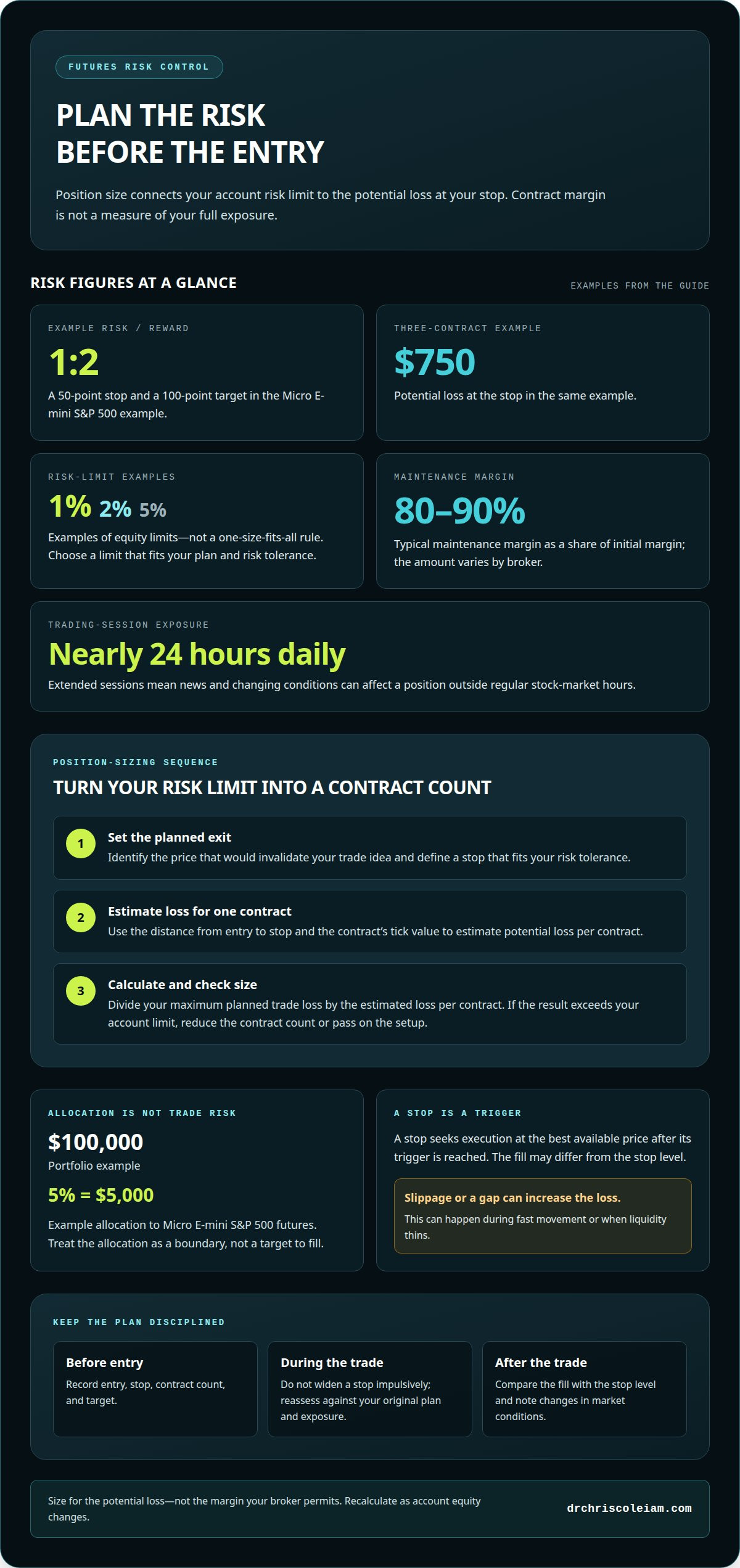
Slippage is the difference between an intended order price and its execution price; a gap occurs when trading resumes at a different price. A stop order may execute beyond its trigger during fast movement. For example, an economic announcement overnight can move Nasdaq futures before your next review. Nearly 24-hour daily trading gives futures traders access to extended sessions, but it also means news and changing market conditions can affect positions outside regular stock-market hours.
Margin Rules and Trading Limits
Futures margin and trading limits depend on contract requirements, exchange rules, and broker policies. There is no single margin amount for every contract. Brokers may require more margin for positions held into the next trading day, and they may liquidate positions after a margin violation. Maintenance margin is the minimum account equity required to keep a position open. Typical maintenance margin is 80-90% of initial margin, though the amount varies by broker.
Futures positions are marked to market at the end of each trading day, with funds added or withdrawn based on settlement. U.S. tax treatment depends on the contract and your circumstances, so keep records of transactions and settlements for tax reporting. Review contract terms and broker requirements before trading, and consider how overnight exposure fits your plan.
What’s a stop order?
A stop order activates when the market reaches its stop price and seeks execution at the best available price. To set a stop and position size, choose an exit level that fits your risk tolerance, estimate the loss per contract at that level, and size the position so the total stays within your account limit.
Setting Stop Orders Within Risk Tolerances
A stop order links an exit point to a planned loss, helping keep exposure aligned with your risk tolerance. First, identify the price that would invalidate your trade idea. Calculate the potential loss from entry to stop for one contract. Divide your maximum planned trade loss by that per-contract amount to determine position size. If the result exceeds your account limit, reduce the number of contracts or skip the setup.
Stop-Loss Orders and Risk-Reward
A stop-loss order defines the planned risk side of a trade, while a profit target frames its potential reward. Compare the distance from entry to stop with the distance from entry to target before placing orders. In one Micro E-mini S&P 500 example, a stop 50 points below entry and a target 100 points above entry create a 1:2 risk/reward ratio. Three contracts would produce a potential $750 loss at the stop.
Stop-Order Limitations
A stop price is a trigger, not a guaranteed execution price. Once reached, a stop order seeks the best available price, so fast market movement can cause slippage and a larger-than-planned loss. A gap can also carry the market past your stop before an order executes. These limitations matter most when liquidity thins or volatility accelerates. Don’t widen a stop impulsively after entry. Reassess the trade against your original plan and exposure.
Strong risk management begins with the initial order plan, not a last-second reaction. Before placing an order, record the entry, stop, contract count, and target. Review the trade afterward: compare the fill with the stop level and note any changes in market conditions. This process helps you refine future stop placement without treating an order as protection from every market move.
What’s futures risk management?
Futures risk management connects account equity, planned trade loss, and contract count. Position sizing turns a risk limit into a practical decision before you place an order.
Position Sizing and Capital Allocation
Capital allocation sets how much money you devote to trading; position sizing determines exposure within that allocation. The distinction matters because margin is not the same as the amount at risk. In one example, Eleanor allocates 5% of her $100,000 portfolio, or $5,000, to Micro E-mini S&P 500 futures. Treat that allocation as a boundary, not a target to fill.
Percentage-of-Equity Limits
A percentage-of-equity limit caps the planned loss on a trade relative to current account capital. Examples use 1%, 2%, or 5% of total capital, but the percentage you choose must fit your risk tolerance and trading plan. Jack Schwager advises limiting risk on any trade to 2% of total equity, ideally 1% or less. Apply your limit to the potential loss at the stop, not the contract’s margin.
Fixed-Fractional Position Sizing
Fixed-fractional sizing risks a set percentage of account equity on each trade. To calculate position size, divide your allowed trade loss by the estimated loss per contract if the stop is triggered. If the result allows only a fraction of a contract, round down to a whole contract or pass on the setup. Recalculate as your equity changes so your risk limit reflects your capital.
Keeping Futures Positions Modest
A smaller position leaves more room for ordinary price movement without letting each fluctuation dominate your account. Don’t choose contract count solely by the margin your broker permits. Estimate potential losses at your planned exit, then account for correlated positions that could move together. Follow the same sizing rule after wins and losses; changing size in response to emotion weakens discipline. Review each trade’s trigger and outcome before adjusting your plan.
Choosing futures contracts based on volatility and tick value
Choose a futures contract by matching its tick value and price behavior to your planned exposure. Tick value shows how much each minimum price increment changes the position’s value; volatility shows how far and how quickly the price may move. Together, these factors help you assess whether a contract fits your account and risk tolerance. Futures trading risk control starts with understanding both, not choosing a contract simply because it is familiar or active.
A 10-point move therefore changes one contract’s value by $50. Calculate the possible effect of your intended stop distance, then consider how many contracts your plan allows. This turns tick value into a practical measure of potential loss, rather than an abstract contract detail.
Assess market conditions before choosing a contract. A volatile session, scheduled economic news, or reduced liquidity can affect how your planned exit works. Compare recent price swings with the distance to your intended stop. If you need a wider stop, recalculate your position size rather than automatically keeping the same contract count. A smaller contract can reduce exposure per contract, but it cannot eliminate the risk of an adverse move.
Build futures trading risk control around a repeatable comparison of contract tick value, current volatility, planned exit distance, and total exposure. For Nasdaq futures, consider whether the market’s pace fits the loss limit you set before entry. If potential losses exceed that limit, reduce your contract count or wait for a setup that fits. This process supports deliberate decisions as conditions change, while keeping the final trade choice tied to your own plan.
Dr. Chris Cole IAM: Dr. Cole’s TradingView Algos
Dr. Chris Cole IAM offers Dr. Cole’s TradingView Algos to support a structured market analysis process. Use them alongside a written plan, not as a substitute for deciding your entry, stop, contract size, and acceptable loss. The tool should fit your method and risk limits.
For Nasdaq futures, Daily Auric Levels for Gold, Nasdaq and S&P 500 Futures provide another reference point for planning around key price levels. The Auric Trading Assistant is also available as a trading tool. Keep your decisions grounded in market conditions and your own risk plan; no indicator removes the possibility of loss.
To discuss educational tools that may fit your trading process, contact Dr. Chris Cole IAM.
Build a Process You Can Repeat
Make risk decisions part of a routine you review after every trade. Record why you entered, what would invalidate the setup, and whether your position followed your plan. Study the outcome without changing your rules to excuse a loss or chase a win. Regular review helps you refine your process over time.
Futures trading risk control becomes more useful when market analysis and execution follow the same process. Dr. Chris Cole IAM offers The 4 Hr Trade Room community, Daily Auric Levels for Gold, Nasdaq and S&P 500 Futures, and Auric Options Levels for GLD, QQQ and SPY. Dr. Cole’s full-time trading experience since 2008 informs his work in financial education.
Keep your plan clear, your exposure deliberate, and your review honest. For a conversation about trading education, contact Dr. Chris Cole IAM. Keep learning, refine your process, and grow as a trader.
Frequently Asked Questions
Are micro futures less risky than standard contracts?
Micro futures usually provide smaller contract exposure, but they don’t remove market risk. A Micro E-mini S&P 500 contract is one-tenth the size of a traditional E-mini contract, so the same index move generally has a smaller dollar effect per contract. Your total risk still depends on contract count, entry, exit plan, and whether you hold correlated positions.
How do overnight and intraday risks differ?
Overnight positions expose you to price changes while you’re away from your screen, including moves tied to news or changing global conditions. Intraday positions are usually closed before the next trading day, but fast moves and thin liquidity can still affect fills. Futures often trade nearly 24 hours daily, so set your review and exit plan around the time you intend to hold.
How volatile are futures markets compared to stocks?
There is no single volatility level that applies to all futures or stocks. Compare a specific futures contract with the relevant stock or index over the same period, looking at price range and speed of movement. Futures prices can react to economic news outside regular stock-market hours. Focus on how a typical move affects your position’s dollar exposure and planned exit.
What Do Market Participants Need to Know?
Market participants need to understand the contract’s underlying market, tick value, trading hours, expiration terms, and margin requirements. For example, Nasdaq futures and Micro E-mini S&P 500 futures track different markets and have different contract specifications. Before trading, know how your broker handles order execution and settlement, and account for scheduled economic announcements that could change market conditions.
What happens if I hold a futures contract until expiration?
At expiration, the contract follows its stated settlement process, which depends on its terms. Some contracts settle in cash; others involve delivery of the underlying commodity. Don’t assume every futures position closes automatically in the same way. Review the contract’s expiration calendar and settlement method, then decide whether to close or roll the position before its final trading period.
What’s a trading plan?
A trading plan is a written set of rules for choosing, entering, managing, and reviewing trades. It can specify which markets you trade, what conditions qualify as a setup, how you define exits, and when you stand aside. For example, record your reasoning before entry and compare it with the outcome afterward. That review turns trading decisions into a process you can refine.